What Makes Asbestos Dangerous and Why Removal Must Be Controlled
Read Time:3 Minute, 33 Second
Asbestos is often discussed as a “material problem,” but the real hazard is an exposure problem. When asbestos-containing materials are intact and undisturbed, they may pose little immediate risk. The danger rises when the material is damaged, cut, drilled, sanded, or otherwise broken down in a way that releases fibres into the air.
In everyday property decisions, the phrase asbestos removal contractor perth commonly sits alongside practical questions about disturbance risk, containment, and disposal planning, because controlled removal is built around preventing airborne fibre spread rather than simply “getting rid of sheets.” Understanding what makes asbestos harmful helps explain why removal is handled with strict controls instead of normal demolition methods.
Why asbestos fibres are a health risk
Asbestos is made of microscopic fibres that can become airborne when materials degrade or are disturbed. Once inhaled, fibres can lodge in lung tissue. Over time, this can contribute to serious diseases, including asbestosis, lung cancer, and mesothelioma.
A key point is that asbestos-related disease is associated with inhalation of fibres, not with the mere presence of asbestos somewhere in a building. That distinction is why risk assessments focus heavily on whether a material is likely to shed fibres.
Common ways asbestos gets disturbed in real life
Most accidental exposures are not dramatic. They come from routine tasks that turn a stable material into dust.
Some common triggers include:
- Renovations that involve cutting, drilling, grinding, or sanding older building products
- Removing old flooring or backing materials without checking what is underneath
- Damage from storms, falling branches, or water ingress that breaks down sheeting
- “Cleanup” attempts that use dry sweeping or household vacuums, which can spread fine dust
Even small disturbances can release fibres, especially when the material is brittle, weathered, or already cracking.
Friable vs non-friable: why condition matters as much as material
Asbestos-containing materials are often described as non-friable (more bonded and less likely to crumble) or friable (easily crumbled, releasing fibres readily). While the classification is important, real-world risk often comes down to condition and how the work is performed.
For example, a bonded sheet in good condition presents a different risk profile than the same sheet after years of weathering, impact damage, or repeated drilling. Controlled removal methods are designed to manage these variables through containment, wet methods, and careful handling.
What “controlled removal” is trying to prevent
Controlled removal is less about speed and more about limiting fibre release and stopping any fibres that are released from spreading.
That usually means focusing on:
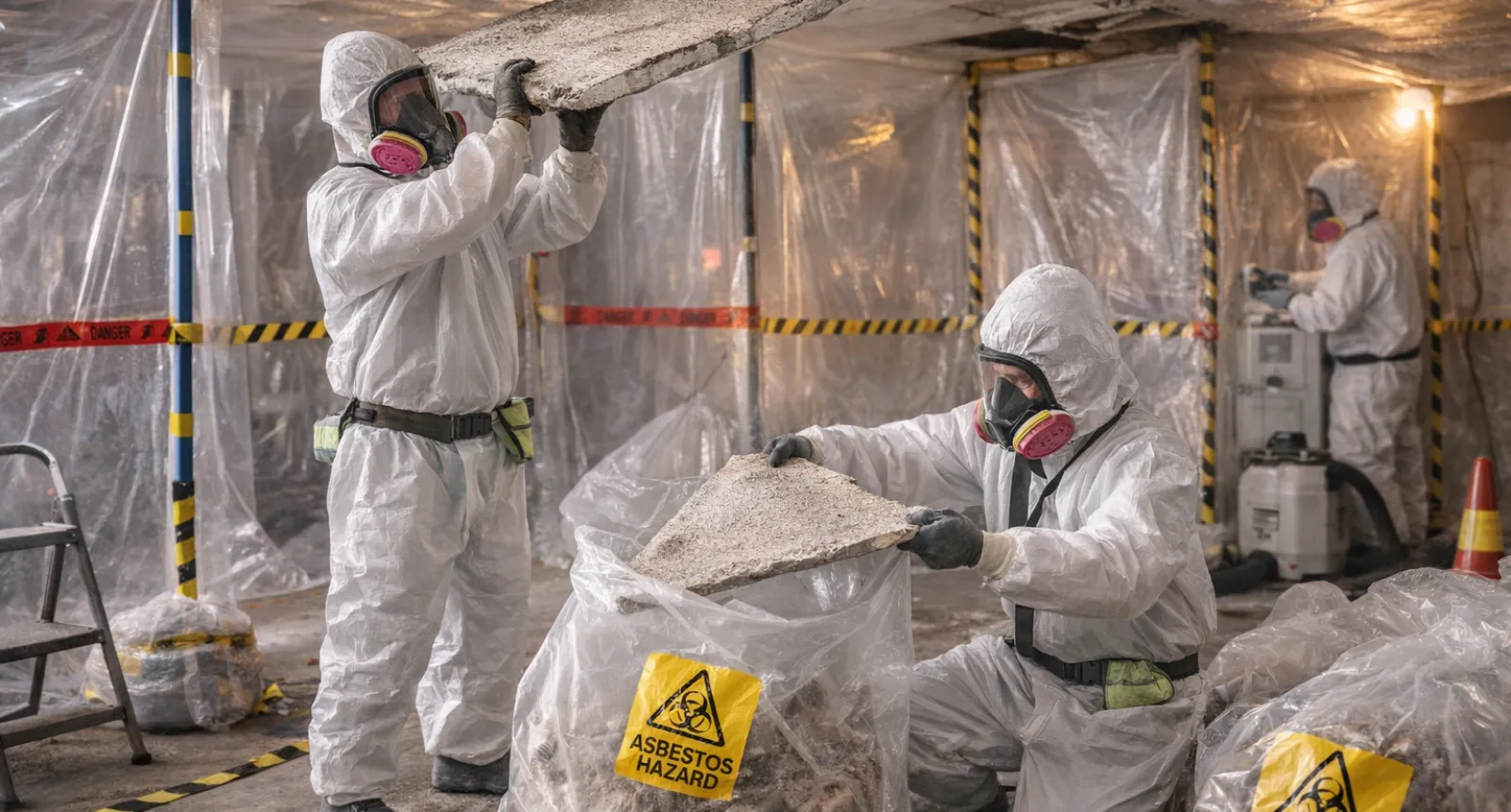
- Work area isolation: Keeping the affected zone separated from occupied spaces
- Dust suppression: Using wet techniques and careful handling to reduce airborne fibres
- Personal protective equipment: Protecting workers from inhalation and contamination
- Decontamination steps: Preventing fibres from being tracked out on clothing, tools, or footwear
- Waste containment: Packaging and labeling so debris does not become a secondary hazard
When people describe asbestos removal as “over the top,” it is often because they are comparing it to normal demolition work. The objectives are different: demolition aims to break down structures efficiently, while asbestos work aims to prevent fibre spread during and after disturbance.
Why “just be careful” is not a reliable plan
A common misconception is that care and common sense are enough. The problem is that fibre release is not always obvious. Asbestos fibres are too small to see, and a surface that looks clean can still have contamination.
Some DIY approaches increase risk even when intentions are good. For example, dry sweeping can re-suspend settled fibres, and standard household vacuums can exhaust fine dust back into the air. Similarly, breaking sheets to “make them easier to handle” creates more fresh fracture points and debris.
Controlled practices exist because they reduce uncertainty, not because every situation is visibly catastrophic.
The role of documentation and end-state verification
Another reason asbestos work is treated differently is that the job is not only removal. It is also about leaving the site in a condition that does not create ongoing exposure risk. That is why processes often include method statements, waste tracking, and clearance steps.
For property owners, the practical benefit is clarity: what was removed, how it was handled, and what controls were used to prevent contamination beyond the work area.

Happy
0 %

Sad
0 %

Excited
0 %

Sleepy
0 %

Angry
0 %

Surprise
0 %
 0
0
 0
0