
What Romance Actually Looks Like at 5am on a Balinese Volcano
Read Time:4 Minute, 52 Second
Most couples who honeymooned in Bali will tell you about the villa pool, the sunset cocktails, the spa treatments that lasted two hours and cost less than a round of drinks back home. Fewer will tell you about the 3am alarm, the pitch-black drive up a mountain road, the cold that surprised them because nobody warned that Bali has cold — and then the moment the sun broke over Mount Agung and turned the clouds below them pink and gold and every shade of color that doesn’t have a name yet. That moment, standing on the rim of Mount Batur with a cup of terrible instant coffee handed over by a guide who’d made this climb four hundred times and still seemed genuinely happy to be there — that was the romance. Not the candles. Not the rose petals on the bed. The volcano at dawn with the person you just married.
Romance is a more complicated thing than the travel industry gives it credit for. It gets flattened into a set of props — champagne, flower arrangements, ocean views, couples’ massages — and those props are not wrong exactly, but they’re not sufficient either. The couples who come home from Bali talking about how the trip changed something between them are almost never the ones who stayed in the villa the entire time. They’re the ones who did something together that was slightly outside their comfort zone, slightly unscripted, slightly more alive than a perfectly curated experience. The good news is that Bali offers both. The romantic honeymoon packages in Bali that actually deliver on their promise are the ones built around this understanding — that luxury and adventure are not opposites, and that the best honeymoon holds space for both.
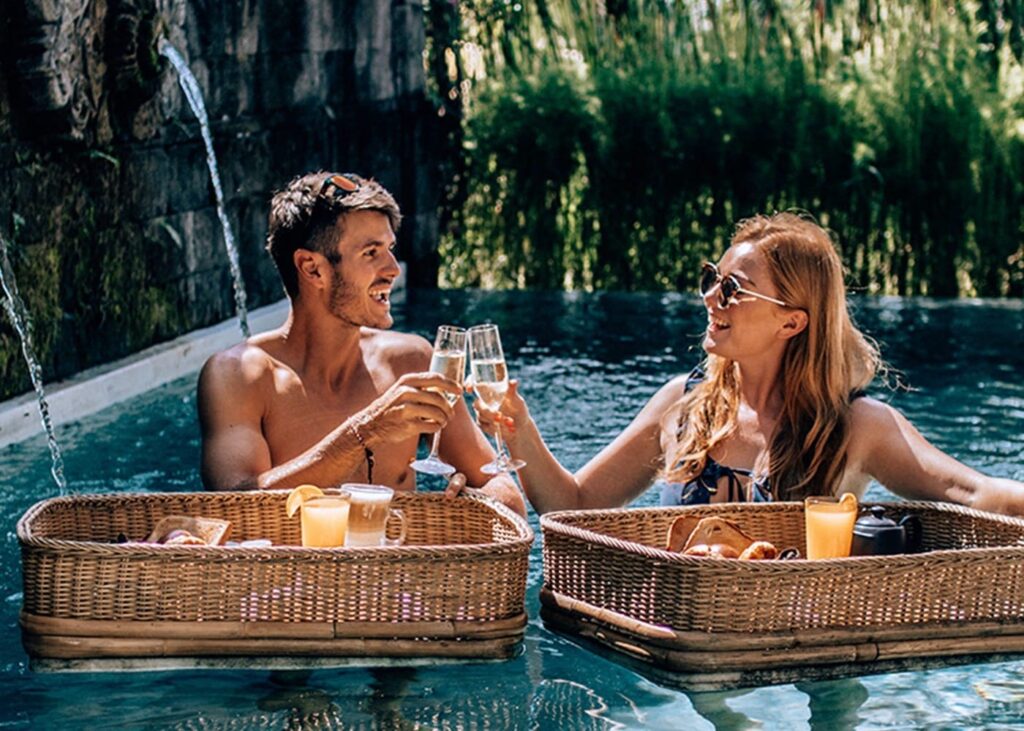
Ubud makes a case for itself as the most romantic part of the island that has nothing to do with beaches. The town sits in the central highlands, surrounded by terraced rice fields and dense jungle, and the air is genuinely cooler than the coast — something that matters more than you’d expect when you’re trying to feel like a human being rather than a slowly melting tourist. The Four Seasons and Komaneka resorts here have a design philosophy that integrates the natural landscape so completely that the boundary between indoor and outdoor essentially disappears. But you don’t need to spend a thousand dollars a night to find that feeling in Ubud. Dozens of smaller boutique properties nestle into the hillsides with private plunge pools and valley views, breakfast delivered at whatever hour you choose, and a silence in the early morning that feels almost sacred. Couples who choose Ubud over the beach towns often describe it as the decision that made the whole trip.
The southern coast offers something entirely different and equally compelling. The Bukit Peninsula — the limestone clifftop area that hangs off the bottom of the island — is where Bali shows its most dramatic geography. Villas built into the cliff face at Uluwatu and Suluban look directly over the Indian Ocean. The surf below is world-class and completely irrelevant to anyone who has no interest in surfing — because the view of it from above, from a private terrace with a cold Bintang at golden hour, is one of the better sights on earth regardless. This part of the island also has a seclusion that the more developed areas have slowly lost. The roads are narrow. The tourist infrastructure is thinner. You’re more likely to encounter a temple ceremony than a beach club, which, for a honeymoon, feels exactly right.
Practical considerations matter even on the most romantic trips, and pretending otherwise helps nobody. The honest conversation about budget — specifically, about where to spend more and where to save — is worth having before you arrive. Bali is remarkable value compared to most honeymoon destinations, but the gap between a mediocre experience and an extraordinary one often comes down to specific choices rather than overall spend. A private villa with a pool costs less than a standard hotel room in Paris. A couples’ massage at a genuinely good spa in Ubud costs less than a mediocre one in any European city. But a last-minute flight because you left booking too late, or a villa that looked perfect in photos and turned out to be next to a construction site — those are expensive mistakes that good planning prevents entirely. Booking two to three months out for peak season, four to six weeks out for shoulder season, gives you access to the best properties at reasonable rates.
The texture of a Bali honeymoon changes depending on how long you stay and how you divide the time. Ten days to two weeks is the sweet spot — long enough to move between regions without rushing, short enough to maintain the intensity of focus that makes a honeymoon feel different from a regular holiday. A rhythm that works beautifully: three nights in Ubud for the cultural immersion and highland calm, two nights in Seminyak or Canggu for the energy and restaurant scene, four nights on the Bukit for the drama and privacy. That structure gives a relationship of its own to the trip — a beginning, a middle, a culmination — rather than a single undifferentiated week in one place.
Bali has hosted enough honeymoons to know what it’s doing. The hospitality is calibrated to couples in a way that feels intuitive rather than transactional. A sarong left on your bed, a frangipani flower on the pillow, a staff member who remembers your breakfast order on day two and has it ready before you ask — these small attentions accumulate into something that feels like the island itself is paying attention. For two people beginning a life together, that quality of being seen and cared for is not a small thing. It’s quietly exactly what a honeymoon should feel like.

Happy
0 %

Sad
0 %

Excited
0 %

Sleepy
0 %

Angry
0 %

Surprise
0 %
 0
0
 0
0