Common Beginner Drills on a Gymnastic Beam
Read Time:2 Minute, 49 Second
For beginner gymnasts, the earliest stages of training are often centred on body control rather than difficult tricks. Learning how to move with precision, maintain posture and stay balanced creates the base for future progress. A Gymnastic Beam is often used for this purpose because it provides a simple but effective way to practise narrow-surface movement in a controlled setting.
Beam drills do not need to be complex to be valuable. In fact, some of the most effective beginner exercises are also the most straightforward. Repeated consistently, these drills can improve confidence and support better overall technique.
Straight walking drills
One of the first beam exercises many beginners learn is simply walking from one end to the other. Although it sounds basic, it teaches several important skills at once. Gymnasts learn to keep the feet aligned, the arms controlled and the eyes looking ahead.
Straight walking also introduces the concept of rhythm. Rather than stepping quickly, athletes are encouraged to move with intention. That helps them understand how balance is maintained across each transition.
Relevé and toe-point exercises
Once a gymnast feels comfortable standing and walking, coaches often introduce relevé work and pointed foot drills. Rising onto the balls of the feet challenges stability and strengthens the lower legs, while toe-point exercises improve form and presentation.
These drills are especially useful because they combine technical detail with balance practice. Even a short sequence can reveal where posture needs adjustment or where the gymnast is relying too heavily on one side.
Simple holds and shapes
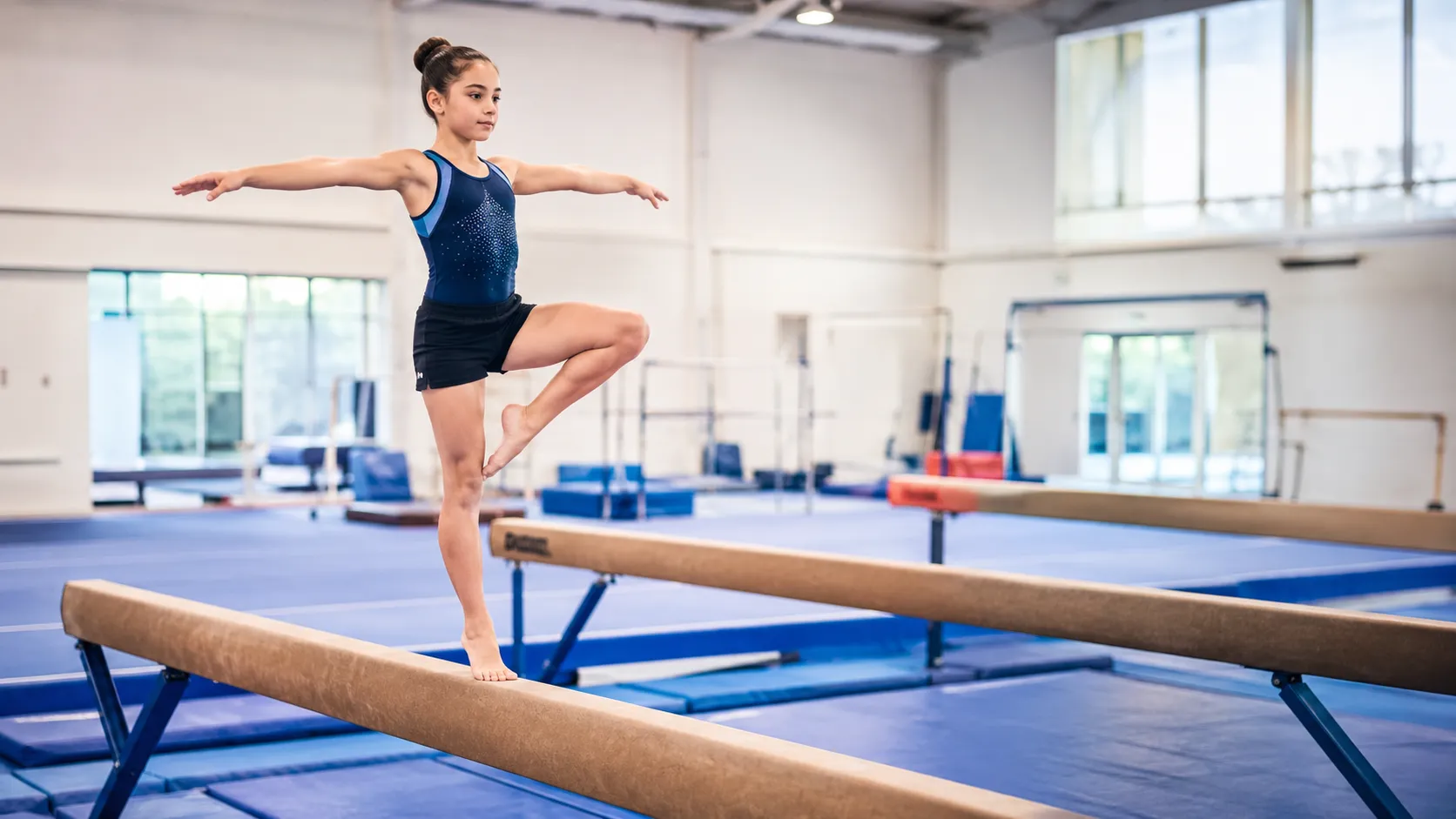
Static shapes are another common part of beginner beam work. Positions such as a tuck hold, arabesque preparation or one-leg balance teach control without requiring travel across the beam. Holding these shapes for a few seconds can be surprisingly challenging, especially for younger athletes.
The benefit of static drills is that they allow the gymnast to focus on alignment. Hips, shoulders and head position all become easier to observe when movement is reduced.
Small kicks and leg lifts
Controlled leg lifts help gymnasts develop strength and coordination while staying balanced. Front kicks, side lifts and low back leg extensions are often used in beginner training because they build awareness of how the body shifts during single-leg support.
These drills also introduce a level of dynamic movement. Instead of balancing in stillness, the gymnast must stay controlled while one part of the body moves. That is an important step toward more advanced beam elements later on.
Safe turns and direction changes
Direction changes are often harder than straight walking. Even a quarter turn can challenge a beginner’s sense of balance. Coaches usually teach these movements slowly, focusing on foot placement and calm upper-body control.
Introducing turns early helps athletes become less rigid in their movement. It also prepares them for routines that require smooth transitions rather than isolated drills.
Why consistency matters
Beginner beam skills tend to improve through regular repetition. A short set of familiar drills practised well is usually more effective than a long routine packed with difficult elements. The aim at this stage is not complexity. It is control, confidence and clean movement patterns.
As those foundations improve, gymnasts are better prepared for the next phase of training. Beam drills may appear simple from the outside, but they often play a central role in developing long-term gymnastics ability.

Happy
0 %

Sad
0 %

Excited
0 %

Sleepy
0 %

Angry
0 %

Surprise
0 %
 0
0
 0
0