Bird Control Products That Actually Last Outdoors: Materials, UV Ratings, and Fixings
Read Time:5 Minute, 37 Second
Outdoor bird deterrents fail for predictable reasons. Sunlight makes plastics brittle. Coastal air corrodes mild steel. Adhesives let go on hot days. Fixings loosen with vibration and thermal expansion. The result is a familiar cycle for facilities teams: a “solution” looks fine for a month, then parts lift, sag or snap, and birds quickly reclaim the space.
If you’re assessing bird control products for commercial buildings, strata properties or industrial sites, durability should be the first filter. Longevity is less about the product category (spikes, netting, wire) and more about what it’s made from, how it’s rated for UV exposure, and whether the fixings suit the substrate and conditions. Here’s how to choose systems that last outdoors and avoid expensive rework.
Materials that hold up in real Australian conditions
Outdoor performance starts with materials that can handle UV, temperature swings, wind load, and corrosive environments. The same product can behave very differently depending on whether it’s installed on a shaded loading dock or a sun-baked parapet near the coast.
Stainless steel vs galvanised steelFor spikes, wire systems and fixings, stainless steel is often the safer long-term choice outdoors, particularly in:
- coastal areas
- industrial zones with airborne contaminants
- rooftops with standing moisture near plant equipment
Galvanised steel can be appropriate in low-corrosion settings, but it relies on its coating staying intact. Scratches, cuts and fastener points can become corrosion starters. Over time, corrosion doesn’t just look bad, it can weaken the system and loosen anchors.
UV-stable polymers and plasticsPlastic components are common in spike bases, netting clips, and some tensioning parts. The weak link is often not the design, but polymer quality. Low-grade plastics chalk, crack and become brittle under Australian UV, especially on north-facing ledges and roofs.
Look for products that specify:
- UV-stabilised polymers (rather than “weatherproof” as a vague claim)
- outdoor-rated nylon or engineered plastics where relevant
- coatings or finishes designed for long exposure
If a supplier can’t describe the plastic grade or UV performance in concrete terms, assume it’s a short-life component.
Netting: polyethylene, knotting and cableFor exclusion netting, durability is influenced by the net material and the perimeter framework.
- UV-stabilised polyethylene netting is commonly used for outdoor exclusion.
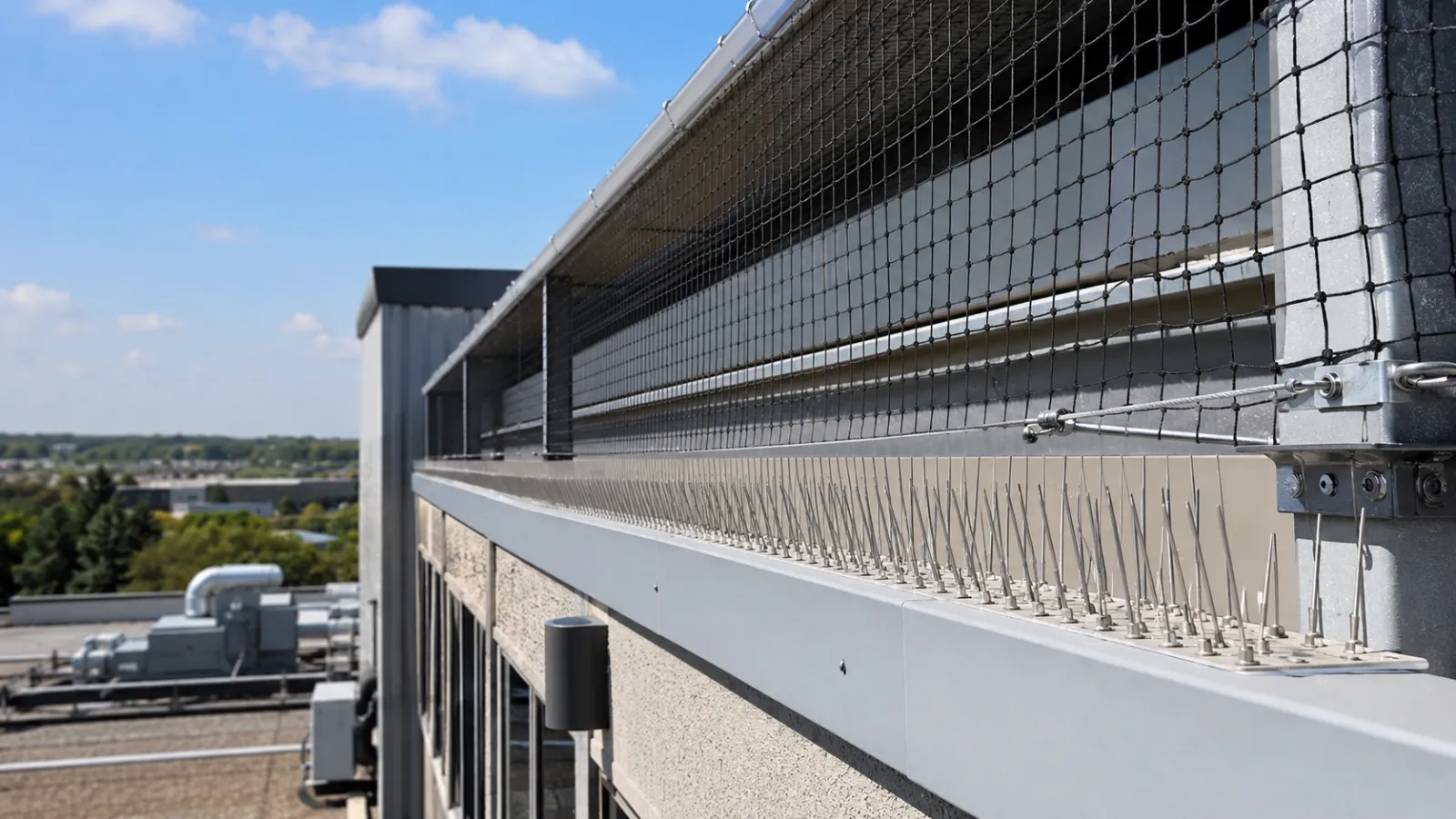
- Cable and perimeter fixings matter as much as the net. Stainless cable and quality ferrules reduce sagging and failure points.
- The way the net is joined and tensioned affects whether it stays taut through wind and heat cycles.
Netting that sags creates pockets where birds can perch or nest, so the “support system” is part of the product, not a separate detail.
UV ratings and coatings: what to look for and what to avoid
UV is one of the biggest reasons bird deterrents fail outdoors, particularly on roofs and open façades. Unfortunately, UV performance is also one of the easiest things to overstate in marketing.
Prefer specific UV claims over generic wording“UV resistant” can mean almost anything. Stronger signs include:
- mention of UV stabilisers in the polymer
- outdoor exposure suitability (for example, long-term exterior use)
- clear guidance about expected service environments (high UV, coastal, industrial)
You don’t always need a technical data sheet for every component, but you should be able to get clarity on whether the product is intended for multi-year exterior exposure.
Coatings are not a substitute for the right base materialPowder coating can improve aesthetics and offer protection, but it won’t compensate for the wrong underlying metal or poor preparation. In harsh environments, coatings can chip, and corrosion can spread underneath.
For high-exposure sites, prioritise:
- stainless steel for key structural elements
- corrosion-resistant fixings
- UV-stable polymers for bases and clips
Coatings then become a bonus rather than the primary defence.
Watch for mixed-material weak pointsA common failure pattern is a high-quality stainless spike strip attached with a low-grade adhesive, or strong netting held up by cheap clips. Outdoor durability is only as good as the weakest component in the system.
Fixings and installation details that prevent early failure
Even premium materials can fail when the fixing method doesn’t match the substrate, load, or environment. Fixings are where “looks fine” becomes “still working in two years”.
Mechanical fixings vs adhesivesAdhesives can work in certain applications, but they are sensitive to surface prep, heat and moisture. On sun-exposed parapets, thermal expansion and hot surfaces can cause adhesive fatigue. For long-term reliability, mechanical fixings are often preferred, especially for:
- high-wind zones
- rough or dusty substrates
- areas with repeated vibration (car parks, loading bays, plant platforms)
If adhesives are used, installation quality matters: clean substrate, correct cure time, and an adhesive rated for outdoor temperature ranges.
Match anchors to the substrateFixings should be selected based on the actual surface:
- concrete, brick, steel, timber and composite cladding all behave differently
- aged or spalled concrete may need remediation before anchoring
- waterproof membranes on roofs require careful planning to avoid penetrations that create leaks
A durable bird control system should not create a new maintenance issue, such as water ingress through a poorly planned roof anchor.
Tensioning and edge detailingFor wire systems and netting, tension is the difference between “deterrent” and “invitation”.
- Wire needs correct spacing and tension to prevent stable landing.
- Netting needs a properly tensioned perimeter and secure joins to eliminate sag pockets.
- Corners, returns and service penetrations are common failure points if not detailed carefully.
A good installer treats edges and penetrations as priority areas, because birds will exploit the smallest gap.
A practical checklist for choosing long-lasting bird control products
When you’re comparing options, focus on the details that predict service life. A durable selection process can be surprisingly simple.
Use this checklist before committing:
- What is the primary exposure: full sun, shade, coastal air, industrial contamination, or high wind?
- Are key components stainless steel where corrosion is likely to be a problem?
- Are plastics and clips clearly UV-stabilised and intended for long-term outdoor use?
- Does the system rely on adhesives, and if so, is the adhesive rated for exterior heat and UV conditions?
- Are fixings matched to the substrate, with a plan that avoids compromising roof membranes?
- For netting and wire systems: how will tension be maintained, and how are corners and penetrations handled?
- Is there a maintenance plan (even minimal) to inspect tension, check fixings, and remove debris?
The most reliable outdoor bird deterrents are rarely the cheapest upfront, but they are often the most economical over time. When materials are chosen for the environment, UV stability is treated as a non-negotiable, and fixings are engineered to the substrate, the system stays intact and birds stop treating your building as a permanent perch.

Happy
0 %

Sad
0 %

Excited
0 %

Sleepy
0 %

Angry
0 %

Surprise
0 %
 0
0
 0
0